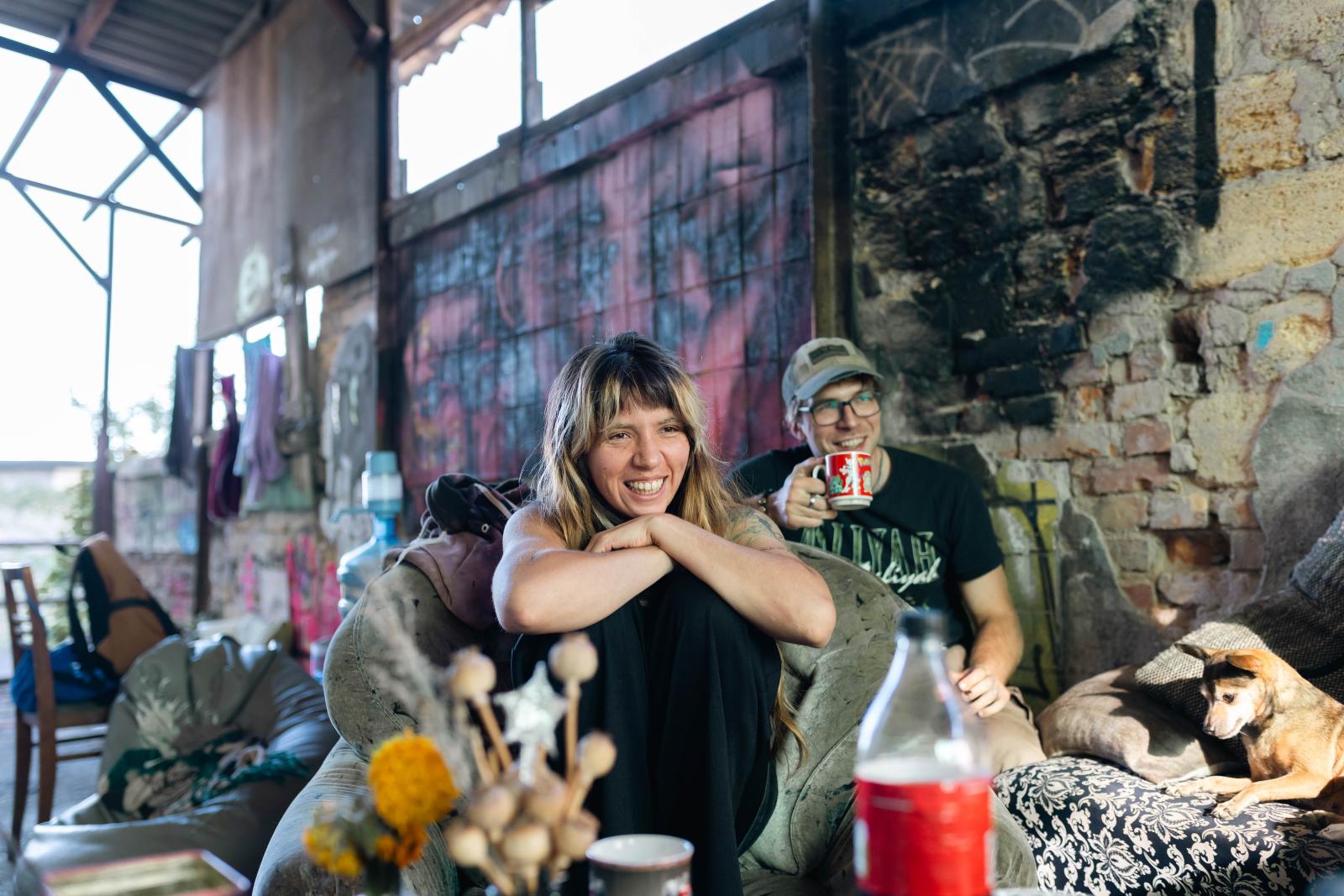
Sonia leans back in an armchair while Boris puffs on a cigarette behind her. Kostya offers us coffee as the sky opens above the wall-less room of the ruins-turned-activist-collective, a stone’s throw from Odesa’s iconic Primorsky Stairs, immortalised in Sergei Eisenstein’s Battleship Potemkin from 1925. In the distance, the city’s harbour frames the bombed-out Hotel Odessa, destroyed in a Russian missile strike. A gentle late summer breeze accompanies the sound of crickets and the occasional air raid alarm.
“We are activists and we are here for political reasons because we understand the causes of homelessness.”
Despite these constant reminders that Ukraine is under attack by Russia under Putin, or maybe because of it, Sonia, Kostya, Boris and the other Odesa residents who make up Street Aid Daily – better known as S.A.D. Collective – dedicate their time to working with homeless people.
“We are activists and we are here for political reasons because we understand the causes of homelessness.”
Destruction of homes, internally displaced refugees and war veterans with physical disabilities and psychological scars are all contributing to a worsening of Ukraine’s homelessness crisis. As a social worker, Kostya was appalled by the way homeless people were being treated with strict behavioural control, having phones and documents taken from them and being exploited through unpaid labour.
“Most organizations that help homeless people in the city are religious, so it was like a certain path – no drugs, no alcohol. For them it was more about morality. But that’s not the way to work with addiction if you want to help people.
S.A.D. Collective sees homelessness not as a moral failure but as a political and structural issue – one that is only getting worse as the war drags on.
So they started initiatives that treat people on the streets as individuals – not as problems. They complement existing food distribution efforts by providing practical items such as clothes, shoes, menstrual pads, soap and hand warmers. Just as importantly, they use creative practices to help people living on the streets express themselves. Together they use art workshops, photography, documentary films, t-shirt printing, zines and other creative outlets to advocate for solidarity and for better political solutions.
Since they started working with homelessness, S.A.D. has attracted growing interest in their work, and have started to connect with other grassroots initiatives in the country and abroad. A documentary film made by collective members is also touring international festivals. This increased and positive attention has also allowed the collective to advocate for better structural and political solutions, such as Housing First Principles as implemented in Finland and Scandinavia.
“War not only showed the need for grassroots organizations, but also the efficiency of them.”
To the members of S.A.D., their work demonstrates the value of local initiatives that address homelessness more humanely than many institutions, relying on human relationships rather than bureaucracy. As Zhenya, another collective member states: “War not only showed the need for grassroots organizations, but also the efficiency of them.”